Named human‑ and data‑centric AI systems — not composite case studies.
Health Enovation does not invent clients for the internet. What follows is work Grace S. Lee led or built: integrated AI, data, and human accountability — in companies, ministries, and the studio itself.
2015–presentHealth Enovation
Health Enovation studio
A practice for human‑ and data‑centric AI system design: integrate people, data, and process before you automate — for investors, founders, life‑science companies, and governments. The studio exists so leaders get whole-system architecture, not another silo or a chatbot parked beside the work.
Investor & startup advisory
Diligence before the money moves.
2016–presentHealth Enovation · PE/VC investors, executives and founders
Investor & startup advisory
Since 2016, Health Enovation has advised and done due diligence for 700+ investors and startup founders. The work is for PE/VC investors, C-level executives, and founders deciding how to build health technology: the business process, the data flow, what customers and patients need, and whether the product can scale and be accepted. The point is to find the obstacles, and the way around them, before they cost a round.
For startups and investors, that covers clinical and AI strategy, regulatory and safety readiness, and technical due diligence. It draws on the same practice Grace S. Lee has used inside pharma, CROs, and ministries for 30+ years. She is also an advisor and Pipeline Angel on health-tech diligence. Founder offers
Grace S. Lee has helped 500+ drug and biotech companies speed up safety analysis and save hundreds of millions of dollars. She has helped get 300+ drugs, biologics and medical devices approved by the FDA, EMA, MHRA and SFDA. Clients include CEOs, CMOs, and CSOs, the FDA, NHS, EMA, the Academy of Medicine, and Ministries of Health. The named work follows, newest first.
Pandemic technology built by a global team Grace S. Lee led. MPC brought data from 15,000+ sources into one picture, tracking public-health mandates, case trends, and clinical study and testing sites in real time across all 50 U.S. states and 3,000+ counties, and in African countries with limited technology resources. People could find what they needed without becoming analysts, and the data helped show how well mandates were working. It is the studio’s public demonstration of a shared brain at population scale.
2017–22, 2020Pfizer (2017–22) · AbbVie (2020)
Real‑world data strategy
Health Enovation designed the Global Medical Epidemiology & Big Data Analytics (real‑world data) strategy and roadmap for Pfizer (2017–22) and AbbVie (2020).
2014–2020Qatar Supreme Council of Health · PA Consulting
Qatar public health platform and National Diabetes Strategy
From 2014 to 2020, Grace S. Lee and her team designed an integrated public health, clinical care, and biomedical research platform for the Qatar Supreme Council of Health. Regulators, policymakers, hospital executives, doctors, researchers, and patients could get the information they needed on demand, from a single source of truth.
Within that work, in 2014–2015, a global team conducted current-state analysis, international best-practice review, and epidemiology to design Qatar’s national diabetes strategy and implementation plan for 2016–2022. The work sat with the Supreme Council of Health and the National Diabetes Committee: prevention, patient empowerment, clinical pathways, workforce, information management, technology, and research as one architecture — not a stack of programs.
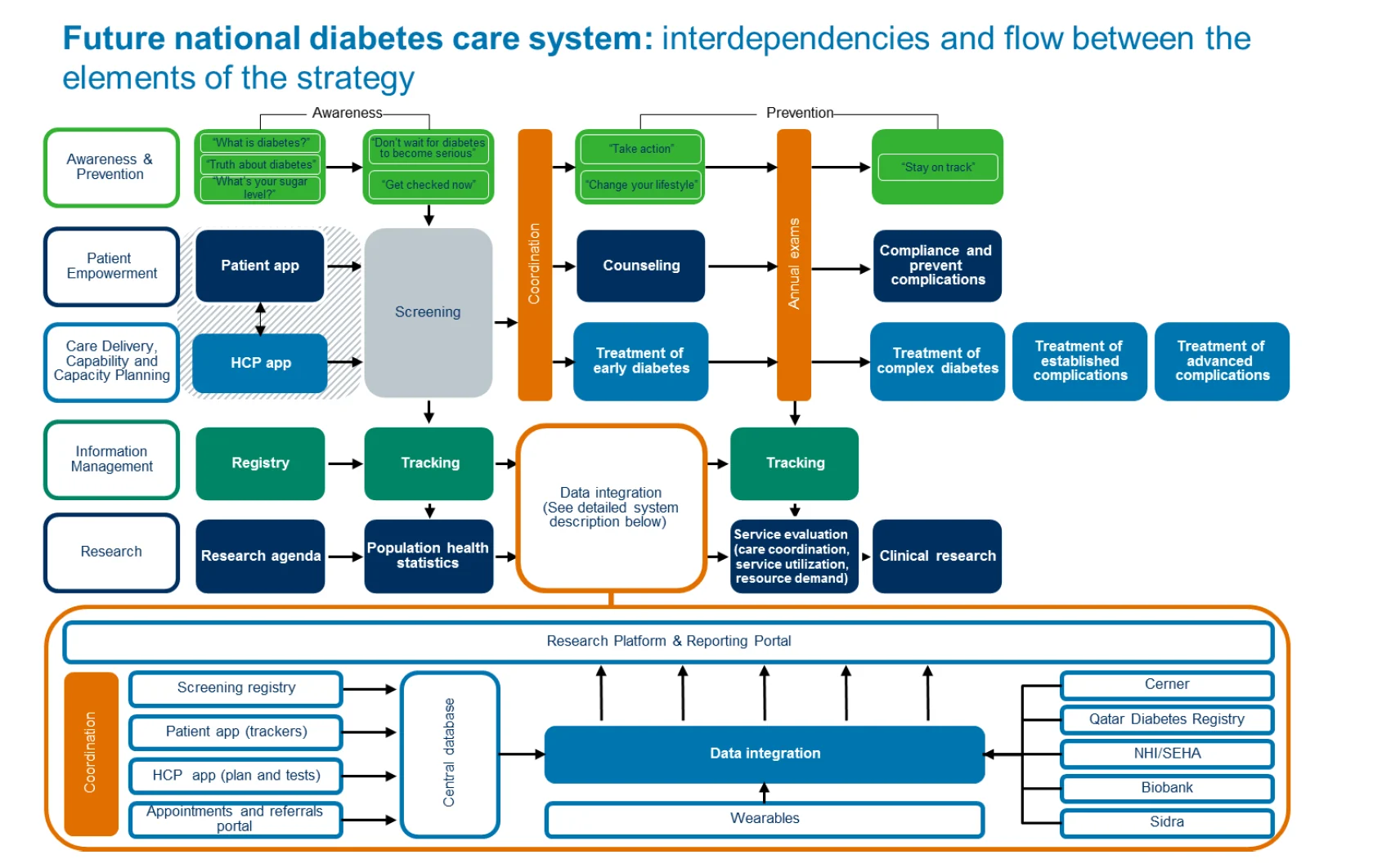
Qatar National Strategy for Diabetes and integrated care system* Author and designer of Qatar’s National Strategy for Diabetes and its International Best Practices Analysis for the Qatar Supreme Council of Health, endorsed by contributors to the US, EU, UK, and Australian diabetes and obesity treatment guidelines. The strategy’s six-pillar national integrated diabetes care and data system connects screening, patient and clinician apps (including the integrated diabetes app Grace designed), the national registry, hospital records (Cerner, NHI/SEHA, Sidra), the biobank and wearables into one research and reporting platform.
(opens the full-size diagram in a new tab)Future national diabetes care system: Qatar National Diabetes Strategy, designed by Grace S. Lee (2015).* It is an integrated ecosystem built from the patient and provider experience, so people, data, technology, and processes work together. Six pillars (awareness and prevention, patient empowerment, care delivery and capacity, information management, research, and coordination) are integrated in data flow, from biobank to medical records to patient trackers, and in time, effort, and resources, with measurable, actionable outcomes. The vision map traces the patient–provider journey; the blue boxes in the middle are the strategy deliverables. Grace also designed the integrated diabetes app for patients and providers. Select the diagram to open it full size.
2011–2014PA Consulting
CLASS — Clinical and Safety Signal Intelligence System
CLASS (Clinical and Safety Signal Intelligence System), which Grace built on Google technology in 2013, was demonstrated on a roadshow with CIOs across the industry, including at the Gartner CIO conference, and presented to the EMA, MHRA, NIHR and top 15 global pharma and biotech companies. It is a pharma intelligence and compliance platform built on Google Cloud (BigQuery) with Google.* It integrated terabytes of real‑world data from 120+ sources, tracked 283 million patient cases and 587,000 serious adverse events (death or hospitalization), and answered questions in just three clicks. Built to meet FDA, EMA and MHRA requirements to compare a drug’s safety profile or effectiveness against competitors or untreated patients — for example, the background rate of second primary tumors in untreated cancer patients, a question CHMP/EMA asks when considering withdrawing a drug. Regulators and patient advocacy groups were design partners; FDA, EMA and MHRA provided input. Language processing read 100,000 sentences in 17 seconds (2013). A clinical trial site performance tool covered 21,860+ sites, work that connects to her IOM/FDA Clinical Site Evaluations platform strategy and the National Academy of Medicine paper on human‑ and data‑centric system design for IOM and US industry-wide clinical trial changes. Co-presented with Google: Big Data in Pharma Europe 2014 with Rob Easton; BRC D2D 2014 “Partnering to Build…”; and with Thanikai Sokka, Google Cloud Platform Strategic Partnerships Manager for Americas. Featured by Google and Gartner at their conferences. Google Partner of the Year, 2012 and 2013.
What sets the design apart is timing and scope. CLASS was briefed to EMA and MHRA around 2013–14, with regulators and patient advocacy groups as design partners — roughly a decade before CIOMS Working Group XIV’s guidance on responsible AI and human oversight in pharmacovigilance (2025–26). The practice came before the written principles. And it was whole-system: AI, multi‑source data, process, and human accountability designed together across signal detection, safety intelligence, and clinical evidence — not human-in-the-loop added as a check on case intake. CLASS is still the pattern Health Enovation uses: safety, evidence, and commercial signal in one place, so a company is not running four truths.
2006–10Pharma company · Covance · Bayer · results presented DIA 2012
Drug-safety language model for case narrative automation
Early language-generation in drug safety: case narrative automation began while at a pharma company (2006–07), then continued at Covance (2008–10) for Bayer and more than 50 other pharma and biotech clients. The 2008 Bayer language model automated safety case narratives by integrating EDC clinical, laboratory and drug safety databases. It showed a statistically significant 89.5% improvement (p<0.001), cutting effort to an average of about 1.2 minutes per narrative draft per patient (York A, Covance, PhUSE 2009; Lee et al., DIA 2012 poster T22). Regulators accepted it in Bayer NDA approvals; the drug is never named. Results were presented at the DIA 2012 Annual Meeting in Philadelphia (authors affiliated with PA Consulting — presentation affiliation only; the 2008 Bayer build was at Covance).* This is language generation for safety narratives with measured effect and NDA acceptance — years before later waves of “LLM in pharmacovigilance” claims — and the start of Grace’s through-line: put AI next to the people accountable for decisions, not as a stand-alone tool.
An integrated Safety Intelligence System that automates safety reporting, surveillance and analytics for regulatory filings, built for Sanofi (2013–14)* and Pfizer (2017–22).
2014J&J · IMI (2014)
Diabetes early-detection language model
An AI language model for early detection of diabetes in medical records, built for J&J and the EU/EFPIA Innovative Medicines Initiative (IMI) in 2014.*
2011–2016PA Consulting · Institute of Medicine
Clinical Site Evaluations platform
Platform strategy for clinical site evaluations, designed for the Institute of Medicine (now the National Academy of Medicine), the FDA, and pharma C-level leaders — human‑ and data‑centric system design for IOM and US industry-wide clinical trial changes.
Global head and senior director roles at Covance and Celgene. At Covance (now Labcorp Drug Development): Global Lead of Clinical Data and Regulatory Strategy — NDA strategy, eCTD preparation, and governance with development partners. At Celgene: Global Lead of Medical Data Strategy & Submissions. The job in both rooms was the same: make medical data a company asset, not a departmental file.
Early 2000sPaper to electronic NDA filings
Serious adverse event automation
As NDA filings moved from paper to electronic submission, Grace’s team built AI automation, using natural-language models, to cut the time it took to process millions of serious adverse event cases by more than 400%.
1999–2001: Led the launch of Lipitor, Viagra, Neurontin and Lexapro for Warner-Lambert, Pfizer and Forest via human‑ and data‑centric integration. Medical communications at Sudler & Hennessey, then Associate Director, Clinical Development at Forest Laboratories. Pivotal NDA work for memantine, first‑in-class NMDA receptor antagonist for moderate-to-severe Alzheimer’s disease. Led the safety team at the FDA Advisory Committee; the committee voted unanimous support, and the product received full marketing approval on the action date.
1997H.E.A.L.
Health Education and Advocacy League
A nonprofit founded for health awareness and patient empowerment in low-income communities. The first rehearsal of the same instinct: put usable information in the hands of the people who have to decide.
* Work delivered while at PA Consulting.
If your system is unnamed, we should name it.
Bring the molecule, the ministry, or the company. We will tell you whether a shared brain is the job — and what the first 90 days must produce.