
Government, Payers, and Non‑Profits
A ministry cannot steer what it cannot see as one picture.
We design national and agency architecture: strategy, shared dataset, and decision rights — so public-health leaders are not governing from incompatible reports.
Concrete offers
Strategy and the system that makes it true.
National strategy design
The Qatar method: current-state, international best practice, epidemiology, and an implementation plan a minister can fund. Prevention, care, workforce, information, and research as pillars of one architecture — not a catalogue of programs.
Shared public-health dataset
One picture for clinicians, researchers, agencies, and the public. Objects, identifiers, and access rules so paper-to-electronic transitions do not become twenty new silos. Patients and operators see the same truth on demand.
Decision infrastructure
Policy and mandate tracking, effectiveness, and population signals — the MPC lineage. MPC, Health Enovation’s integrated data and AI platform, brought data from 15,000+ sources across 50 states and 3,000+ counties into one picture. Built so a government can see whether a rule is working, not only whether it was published.
Collaborative brain
Architecture for agencies that currently exchange PDFs. Decision rights, a live operating picture, and integrative AI that sits inside the ministry’s work — surveillance, chronic disease, or emergency response.
Proof of method
Qatar’s National Diabetes Strategy. MPC at population scale.
The government practice is not a slide about digital transformation. It is the same craft used when a young country needed a national diabetes architecture, and when fifty U.S. states needed a way to see mandates and care as one public picture.
Qatar National Strategy for Diabetes and integrated care system* Author and designer of Qatar’s National Strategy for Diabetes and its International Best Practices Analysis for the Qatar Supreme Council of Health, endorsed by contributors to the US, EU, UK, and Australian diabetes and obesity treatment guidelines. The strategy’s six-pillar national integrated diabetes care and data system connects screening, patient and clinician apps (including the integrated diabetes app Grace designed), the national registry, hospital records (Cerner, NHI/SEHA, Sidra), the biobank and wearables into one research and reporting platform.
Clinical Site Evaluations platform* Designed the Clinical Site Evaluations platform strategy for the Institute of Medicine (now the National Academy of Medicine), the FDA, and pharma C-level leaders. Co-author, National Academy of Medicine paper on harmonizing clinical trial site standards (2017), with Pfizer’s chief medical officer and a medical school dean.
CLASS safety-signal AI* Built CLASS with Google, regulators, pharma and data providers, for pharmacovigilance and real‑world evidence. Google Partner of the Year, 2012 and 2013.
Diabetes early-detection AI · J&J and IMI (2014)* Built an AI language model for early detection of diabetes in medical records, for J&J and the EU/EFPIA Innovative Medicines Initiative (IMI), Europe’s public-private partnership for health research.
Write from the agency. Name the population, the decision, and the date it has to be usable.
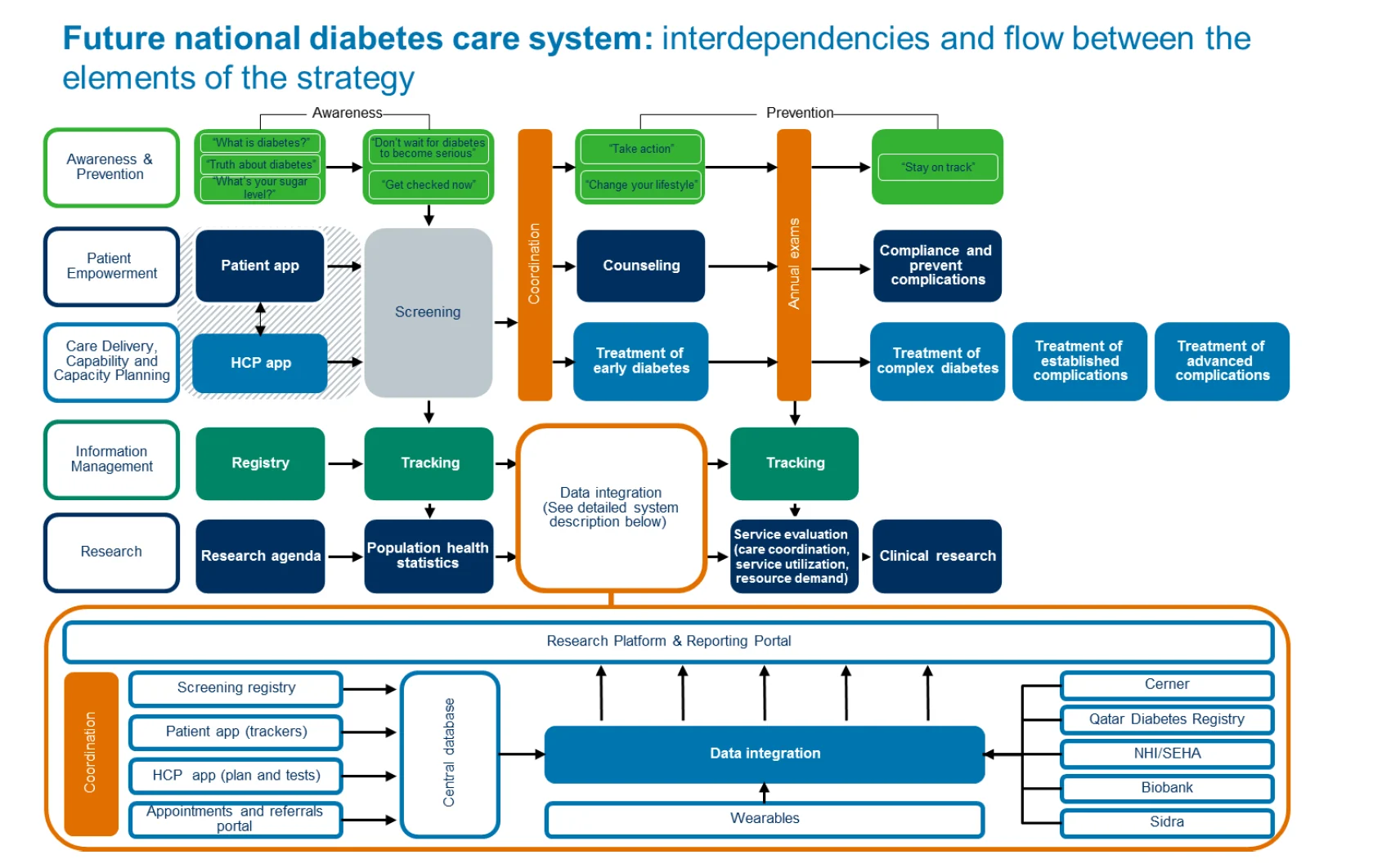 (opens the full-size diagram in a new tab)
Work delivered while at PA Consulting.